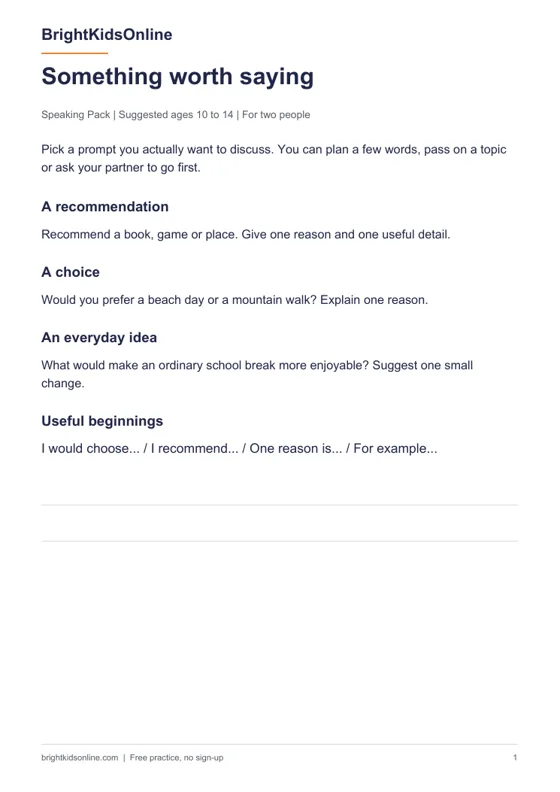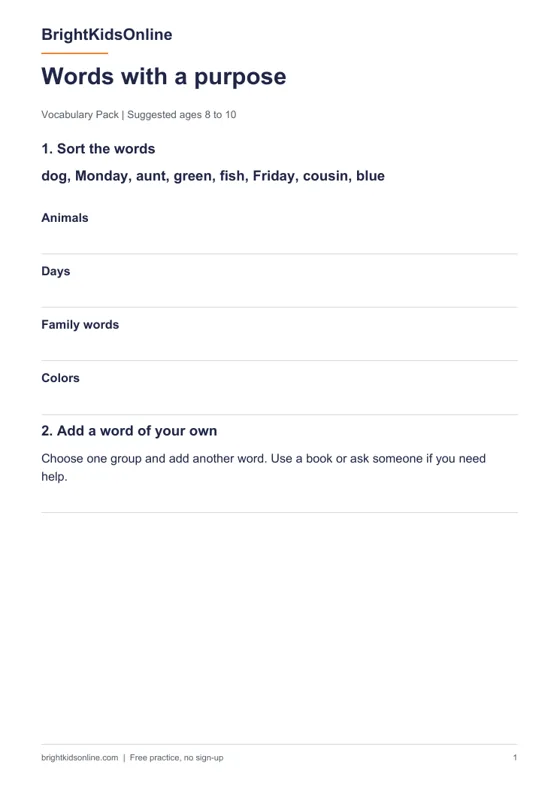


To help your child read in English at home, choose a text they can mostly follow, read it together and talk about meaning without turning every page into a test. Ten enjoyable minutes that happen regularly are more useful than a difficult book that creates tension. Your child can listen, join in, reread and gradually take more of the reading.
Choose a book that invites your child in
Start with interest, not a reading level printed on a cover. A child who loves animals may work harder to understand an animal fact book than a technically easier story that feels babyish. Let your child choose between two suitable options. For ages 6 to 8, look for clear pictures, repeated phrases and short sections. Older children may prefer comics, recipes, sports profiles, jokes, short nonfiction or graded readers connected to their interests.
Check one page together. If nearly every sentence contains several unknown words, the book may be better as a read-aloud than independent reading. That is not a failure. Listening to a parent or audio while following the text can still build familiarity with English rhythm, vocabulary and story structure.
Use a simple shared-reading routine
The What Works Clearinghouse describes shared book reading as an adult and child actively engaging with a text through questions, explanations and connections. The British Council also recommends pictures, repeated readings and allowing children to join in at their own pace. You can turn those ideas into three clear stages.
Before reading: look and predict
Spend one minute on the cover, title and pictures. Ask one genuine question: “What do you think this is about?” or “Which character would you follow?” Introduce two words that are essential for understanding. Do not teach every unfamiliar word in advance.
During reading: share the work
Read a paragraph each, let your child read a character’s dialogue or echo one useful sentence after you. Pause where the story naturally creates curiosity. If your child hesitates over a word, wait, point to a helpful part or say the word and continue. Constant stopping makes it hard to hold the meaning of the sentence.
After reading: talk, do not quiz
Ask about one idea rather than checking ten facts. Try “What surprised you?”, “Why did she do that?” or “What would you change?” A drawing, a quick retelling with toys or choosing a favourite line can show understanding without a worksheet.
Reread with a new purpose
Children often ask for the same story again because familiarity frees them to notice more. Change the purpose slightly each time. On the second reading, look for three action words. On the third, notice how a character feels. Later, ask your child to retell the page or find a phrase that could be used in daily life.
Rereading should not become reciting under pressure. If your child knows a repeated line, pause and invite them to join in. If they do not, simply continue. The book should remain a shared experience, not a hidden memory test.
Support decoding without losing the story
When a child meets an unfamiliar word, first ask whether it is important. A picture or the rest of the sentence may provide enough meaning. For an important word, say it clearly, give a short explanation and reread the full sentence. Add only a few useful words to your child’s vocabulary notebook.
If your child is learning letter sounds and decoding, follow the approach used by their school or teacher so the cues do not conflict. Reading for pleasure and structured phonics practice have different jobs. A story can be enjoyed even when an adult reads most of it. For more playful review, use these English vocabulary activities at home.
Adapt English reading by age
- Ages 6 to 8: use illustrated stories, rhyme, repetition and short read-aloud sessions.
- Ages 8 to 10: alternate pages, act out dialogue and keep a simple list of favourite words.
- Ages 10 to 12: add comics, short information texts and questions that invite an opinion.
- Ages 12 to 14: offer real choice, including articles, biographies, game instructions or adapted novels. Discuss ideas without asking for a school-style report every time.
An older beginner still needs accessible English, but not childish content. A short text about a favourite athlete may be a much better starting point than a picture book designed for very young native speakers.
Build a routine your family can keep
Choose a reliable cue such as after dinner, before bed or Saturday breakfast. Put the book where it can be seen, remove other screens for a few minutes and stop before attention disappears. On a busy day, one page still counts. Invite your child to browse alone too, without asking for proof afterward.
If reading regularly causes distress, or your child has persistent difficulty in both their home language and English, speak with their school. A language teacher can help when the main need is English vocabulary, fluency or comprehension, but does not diagnose reading disorders. For structured language support, learn about online English lessons for children or request an introductory class.
Sources
Something to try together
Common questions
What parents often ask
Choose age-respectful books linked to your child’s interests and with text they can mostly follow. Pictures, repetition and short sections help beginners, while older children may prefer comics, nonfiction, biographies or graded readers.
No. Let pictures and the sentence provide clues when possible. Explain or translate briefly when a word is essential to understanding, then reread the whole sentence so the story keeps moving.
Yes. Familiarity lets children notice new words, join repeated lines and think more deeply about the story. Give each rereading a light purpose without turning it into a memory test.
Speak with the child’s school about the pattern you notice. An English teacher can support language learning, but persistent reading difficulty across languages may require assessment by an appropriately qualified education or health professional.