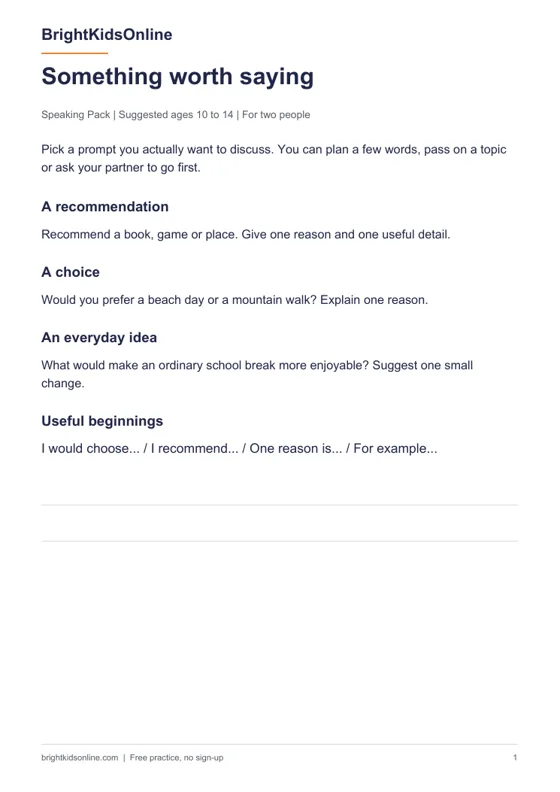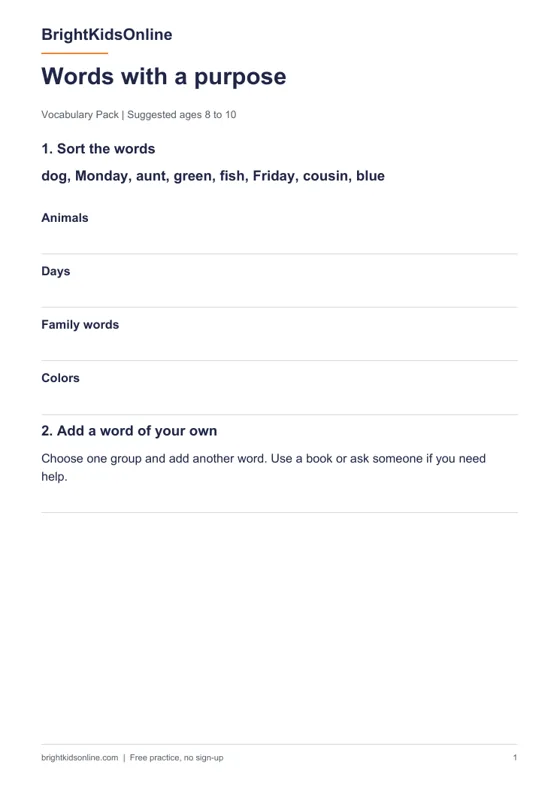


The best vocabulary activity is one that makes a child retrieve and use a word, not only look at it. You do not need a large set of flashcards or a parent who speaks perfect English. Pick a small theme, reuse the words in several ways and bring older words back before they are forgotten. These 12 activities work with paper, household objects and ordinary family conversations.
Before you start: choose a useful word set
Choose six to ten words connected to something your child can see, do or discuss. “Food for a picnic” is easier to use than an unrelated list of twenty nouns. Include words your child partly knows and two or three new ones. For older children, add phrases such as “in my opinion,” “similar to” or “I would rather,” not just single words.
Cambridge English recommends short, regular activities linked to a child’s interests and using vocabulary in real places. The kitchen, bedroom and journey to school can all become useful learning spaces.
12 English vocabulary activities
1. The five-minute word hunt
Choose a category and find matching objects around the home. Try “something soft,” “three things made of wood” or “objects we use for cooking.” Younger children name each object. Older children describe it or explain its purpose without saying its name.
2. Mystery bag
Put four familiar objects in a bag. Your child feels one without looking and describes it: “It is small, hard and round.” Swap roles. This practises adjectives and questions as well as nouns.
3. Odd one out
Say four words, such as “apple, banana, carrot, orange.” Ask which word is different and why. More than one answer can be sensible.
4. Draw, label and explain
Ask your child to draw a bedroom, dream playground or imaginary creature. Add five labels, then use them in sentences. “My creature has enormous wings” gives the new adjective a memorable picture and purpose.
5. Category race
Set a gentle one-minute challenge: how many animals, school items or action verbs can you remember together? Do not make speed the only goal. Afterward, choose three words and place each in a sentence.
6. The memory chain
Begin with “I packed my bag and I took a book.” The next person repeats the sentence and adds an item. Cambridge English uses this familiar game to practise vocabulary and memory.
7. Open a home shop
Use food packets, toys or drawings as products. One person is the shopkeeper and one is the customer. Add useful phrases: “How much is it?”, “Have you got…?” and “I would like…”. Children practise words more deeply when they need them to complete an exchange.
8. Describe and guess
Choose a word without showing it. Give clues about appearance, place, function or category. “You find it in a classroom. It has pages. You can write in it.” If your child is stuck, offer a sentence frame rather than the answer.
9. A changing word wall
Display eight current words on a cupboard or pinboard. Add a sketch, example or translation only when useful. At the end of the week, let your child choose which words are ready to move into a “known words” envelope. Bring two back next week for review.
10. A three-picture story
Choose three family photos, magazine pictures or quick drawings. Put them in an order and tell a short story using the target words. Older children can change the order and explain how the story changes.
11. Become a listening collector
Listen to a short, age-appropriate English song or clip. Choose one purpose before pressing play: listen for food words, movement verbs or phrases that show an opinion. Collect three examples, check their meaning and use one later in the day.
12. Set a weekly word mission
Pick one word or phrase to use naturally three times during the week. A younger child might use “careful”; an older child might try “on the other hand.” Keep a simple mark each time someone in the family notices it. The mission turns recognition into active vocabulary.
Help new words stick
Use the same word across listening, speaking, reading and writing. A child might hear “crunchy” in a clip, use it in the home shop, add it to a drawing and notice it in a story. That variety is more useful than copying the word many times without context.
Review after a gap. At the start of a new activity, bring back two older words and mix them with the current set. If your child cannot remember one, give a clue and move on calmly. Difficulty retrieving a word is information about what needs another encounter, not a reason for embarrassment.
Match the activity to the child
With a younger child, keep the word set small and use movement, pictures and objects they can touch. An older child can work with definitions, short stories and useful phrases from school subjects, films, games or other real interests. If an activity feels too young, invite your child to change it with you.
Vocabulary becomes valuable when it supports communication. Pair these games with my guide to helping a child speak English confidently. If books are part of your routine, my guide to reading English at home shows how familiar words can return in stories. You can also explore my English lessons for children if your child needs a structured learning plan.
Sources
Something to try together
Common questions
What parents often ask
Start with a small, useful set that your child can meet several times in context. Six to ten words may be manageable, but reduce the number if they are all new or increase the challenge for an older learner with phrases and examples.
Games are useful when they make a child recall, understand and use words. A short list can help organise learning, but children also need to hear the words, retrieve them after a gap and use them in meaningful phrases.
Review briefly across the week rather than waiting for one long session. Mix two or three older words into new activities and return to difficult words calmly in a different context.
Use topics they genuinely care about, then practise definitions, opinions, comparisons, short stories and useful phrases. Invite them to choose clips, games or school topics so the activity does not feel designed for younger children.