

If your child understands English but becomes quiet when it is time to speak, start by making speaking feel safe, useful and small. A confident speaker is not a child who never makes mistakes. It is a child who is willing to try, pause, find a word and continue. That willingness grows through encouraging conversations, not tests around the dinner table.
Confidence starts with feeling safe
Children can know an answer and still worry about saying it aloud. They may be comparing themselves with a fluent classmate, expecting instant correction or simply needing more time to prepare a sentence. Instead of saying, “Speak English now,” give the conversation a clear reason. Ask your child to choose a film, explain a game, order an imaginary snack or tell a toy what to do.
The British Council advises parents to use simple language, repetition, gestures and longer pauses when practising English at home. It also stresses the value of praise and positive support. That does not mean praising everything vaguely. Notice the useful action: “You explained that clearly,” “I heard your new word,” or “You kept going even when you had to think.”
Make speaking small and regular
A short speaking habit is easier to repeat than a long lesson at home. Choose one familiar moment and attach two or three English phrases to it. At breakfast, ask “What would you like?” At the door, try “What do we need?” After school, ask “What was funny today?” Keep the exchange brief enough that it finishes well.
Cambridge English recommends learning little and often, keeping activities short and following the child’s interests. This matters for ages 6 to 14. A seven-year-old may happily talk through a puppet. A twelve-year-old may prefer to review a football clip, describe a drawing or explain how a game works. The topic can change while the purpose stays the same: your child uses English to communicate something real.
Use a speaking ladder
Do not jump from silence to open conversation. Give your child a manageable next step.
Five steps from easy to independent
- Point or choose: “Apple or banana?” The child can point first, then say the word.
- Complete a phrase: “I would like…” gives a safe beginning.
- Use a full sentence: “I would like the red apple.”
- Add one detail: “I would like the red apple because it is sweet.”
- Ask back: “What would you like?” turns practice into conversation.
If a step feels difficult, move back one level without making it a failure. The ladder is also useful for group situations. Your child can prepare one sentence before speaking to a teacher or classmate, then gradually rely less on preparation.
Correct without stopping the conversation
Correcting every error can make a careful child even quieter. Decide whether the mistake blocks meaning. If your child says, “Yesterday I go to the park,” answer naturally: “You went to the park? Who did you go with?” They hear the correct form while their story remains important. Save direct correction for one small target that your child is already learning.
Avoid asking a child to repeat the same sentence several times in front of other people. Pronunciation grows through listening and repeated use. Songs, short audio clips and reading dialogue aloud can provide a model without turning every family conversation into a lesson.
Adapt the practice to your child’s age
- Ages 6 to 8: use movement, toys, picture choices and repeated story lines.
- Ages 8 to 10: try guessing games, mini role-plays and descriptions of familiar places.
- Ages 10 to 12: discuss hobbies, compare two pictures or plan a simple weekend activity.
- Ages 12 to 14: let your child choose topics, prepare opinions and practise situations they actually face.
Some children enjoy performing. Others speak best while drawing, walking or doing a practical task. In my lessons, I adapt the prompt and the amount of support so that speaking feels possible without becoming childish. You can read more about how I teach and adapt lessons.
When structured lessons can help
Home practice is valuable, but it may not provide enough fresh conversation or level-appropriate feedback. A teacher can create a clear progression, notice patterns and give a child a reason to speak beyond the family. If your child needs guided conversation, explore English lessons for children or read whether online English lessons are effective for children.
Look for progress in small signs: your child answers more quickly, adds a detail, asks a question or tries again after getting stuck. Those changes matter more than sounding perfect. The goal is comfortable, meaningful use of English.
Sources
My child understands English but does not speak
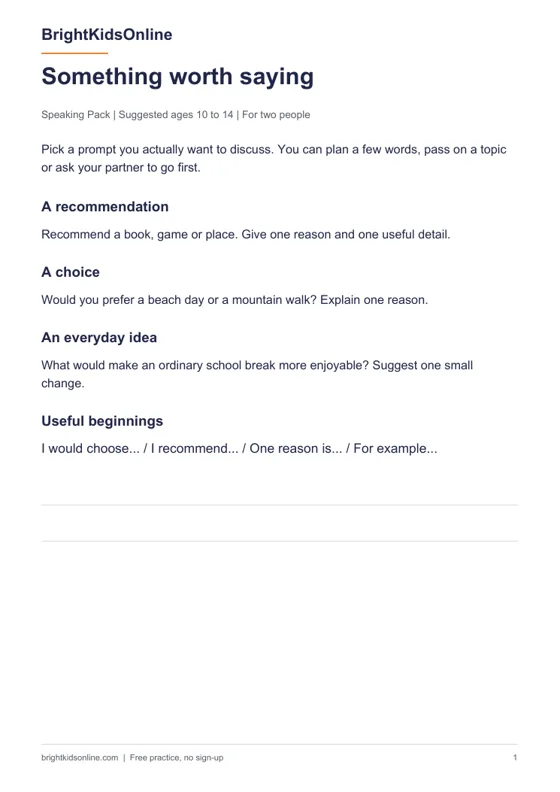
Notice what happens first: does your child hesitate mainly in front of someone, or also search for words at home? Offer two possible answers, then a sentence beginning such as “I like…”. Give your own answer too and leave thinking time. The aim is an exchange, not a perfect answer to every question.
Something to try together
Common questions
What parents often ask
Give your child frequent, low-pressure reasons to speak about familiar interests. Start with choices or sentence starters, allow thinking time and praise the effort to communicate rather than demanding perfect grammar.
No. If you understand the message, model the correct phrase naturally in your reply and keep the conversation moving. Directly correct one useful target at a time when your child is ready to practise it.
Yes. You can encourage practice, use reliable audio or books, ask simple questions and show that mistakes are normal. A teacher can provide accurate language models and targeted feedback when needed.
Short, repeatable practice is usually more useful than an occasional long session. Begin with a few focused minutes and stop while your child is still engaged, adjusting the length for age, interest and energy.