
A child who understands French but rarely speaks it may need more time, confidence or reasons to use the language. Understanding and speaking are different tasks. Your child can recognise words and follow meaning before they can retrieve those words quickly enough to answer. Pressure often makes that gap feel wider.
This pattern is not automatically a problem. Look at the whole picture: which language your child uses with each person, where they hear French, whether they ever speak it spontaneously and how they communicate in their other language or languages. The aim is to create safe, useful opportunities rather than force a performance.
Why understanding may come before speaking
Listening lets a child use context, facial expression, familiar routines and the speaker’s words to build meaning. Speaking asks them to choose vocabulary, organise grammar, pronounce the sentence and decide whether it is safe to take the risk. That is a larger load, especially in a fast conversation.
Your child may also know that answering in another language is quicker. If the adult understands that reply, the conversation moves on and French stays passive. This is not laziness. It is an efficient habit that can change when speaking French becomes manageable and worthwhile.
Find the moments when French already appears
For a week, notice without correcting. Does your child sing part of a French song, repeat a funny line, answer a younger child, speak during pretend play or use French with one particular relative? These moments show where confidence and purpose already meet.
Also notice the questions that close conversation. “Say this in French” can feel like a test. A long open question may require too much language at once. The same child may respond more easily to a choice, a sentence starter or a playful role.
Lower the pressure without giving up on French
Give your child enough wait time. Adults often answer their own question just as the child is preparing a response. Keep your face interested, not expectant, and resist repeating the prompt more loudly. If the answer comes in another language, acknowledge its meaning and model a short French version naturally.
For example, if your child says “I want the blue one,” you can respond, “D’accord, tu veux le bleu.” You have supplied useful French without demanding repetition. On another day, pause before the final word and let them add it. This technique keeps the exchange real.
Create a genuine reason to speak
Children speak when language does something for them. Try situations where a small amount of French unlocks the next step:
- a guessing game with two or three sentence frames;
- a pretend café where the child chooses the order;
- instructions for a drawing that the adult cannot see;
- a short voice message to a willing relative;
- a treasure hunt using familiar location words;
- choosing music, a snack or a family activity with a French phrase.
Keep the language small enough for success. Reusing five helpful expressions in several games is more likely to build fluency than changing the vocabulary list every evening.
How to respond when the French is imperfect
Answer the message before the form. If your child says, “Moi vouloir jus,” respond to the request and then model, “Tu veux du jus.” There is no need to explain every grammatical point during a conversation. Choose corrections that help the child be understood, and leave room for the pleasure of having communicated.
Avoid asking the child to demonstrate French in front of guests. Even confident learners can go quiet when language becomes a performance. Let your child choose whether to share.
When to ask for more help
If your child communicates comfortably in another language but uses little French, focused speaking practice may be the missing piece. A teacher can prepare the words, give generous response time and build conversation step by step. Read the companion guide on supporting French when the parent is not fluent for simple routines between lessons.
If you are concerned about understanding, speech or communication across all the languages your child uses, or if skills have gone backwards, contact the school, doctor or an appropriately qualified speech and language professional. Learning multiple languages is not, by itself, the cause of a language disorder.
Guided French speaking practice
In my online French lessons for children aged 6 to 14, I use games, choices, conversation and age-appropriate topics to make speaking feel purposeful. I adapt the level and allow the child time to formulate an answer. The goal is comfort using French, not a perfect performance.
You can book a free introductory session if you would like your child to try this style of interaction. Tell me where they already hear French and when they are most likely to use it, so the first conversation starts from something familiar.
Sources and further reading
- American Speech-Language-Hearing Association: Learning more than one language
- HealthyChildren.org: Myths and facts about bilingual children
- Education Endowment Foundation: Oral language interventions
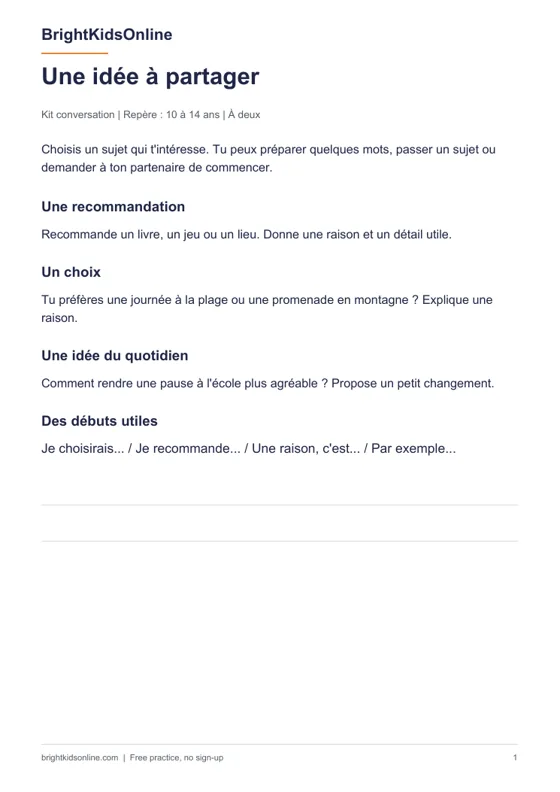
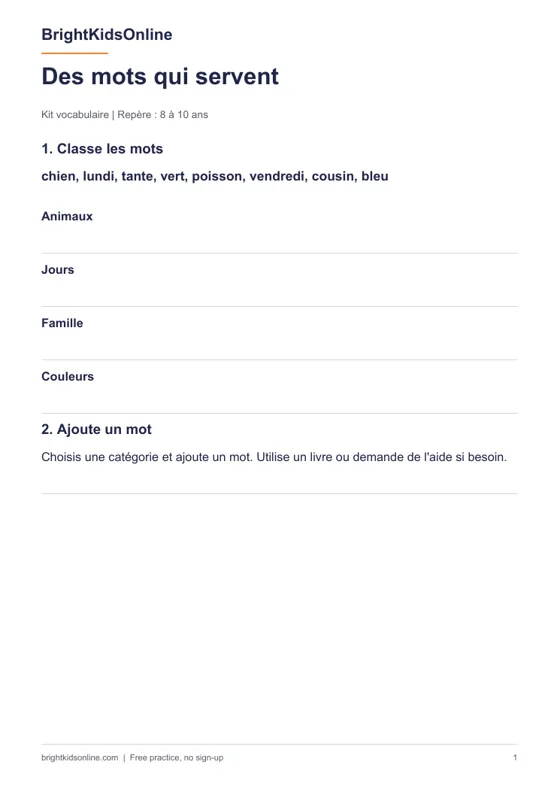
Something to try together
Common questions
What parents often ask
Pressure can make speaking harder. Acknowledge the child’s meaning, model a short French response and create repeated low-pressure chances to use it. Build from one word to a fuller sentence.
No. Understanding and speaking require different skills, and children often understand more than they can say quickly. Look at exposure, confidence, purpose and communication across all their languages.
Speak with the school, doctor or a qualified speech and language professional if you are concerned about understanding or communication across all languages, or if your child loses skills they previously had.