
To help your child with English pronunciation, choose one useful word or short phrase, listen to a clear model and give them a reason to use it. Keep practice brief. Respond to what they mean before correcting a sound. You are helping them be understood, not asking them to erase their accent.
If your child knows a word on paper but hesitates to say it, more spelling practice may not be the next useful step. They may need to hear it, notice a sound and try it in a small exchange. Here is a practical way to do that together.
Choose one small target
Start with something your child wants to say: a favorite animal, a food to order or a phrase for a game. Ask, “Which word would you like to try?” A single useful word gives you a clearer focus than correcting every sentence.
Listen to the whole word first. English spelling is not a dependable pronunciation guide: ship and sheep have different vowel sounds, while a familiar letter can sound different in another word. A recording is usually more useful than inventing a spelling in your home language.
Try this five-minute pronunciation routine
- Listen for one minute. Play one short dictionary recording or a line from a suitable story. Listen together before asking your child to say anything.
- Notice for one minute. Give two choices. Can they hear ship or sheep? Pointing is a valid answer. If the difference is unclear, listen again.
- Try for one minute. Say the word gently, then a short phrase. Offer your own turn first. Avoid making your child repeat it until they are frustrated.
- Use it for two minutes. Hide a picture and describe it, ask for an object or give a partner a choice. “I can see a sheep. What can you see?” creates a message, rather than another sound test.
These times are a convenient plan, not a rule. Finish earlier if your child has had enough. You can return to the same word another day, with a different picture or question.
What should parents listen for?
Choose a pattern only if it affects a word your child uses. Children have different needs; a home language or nationality does not tell you which sounds an individual child finds difficult.
| Try | Listen for | Use it |
|---|---|---|
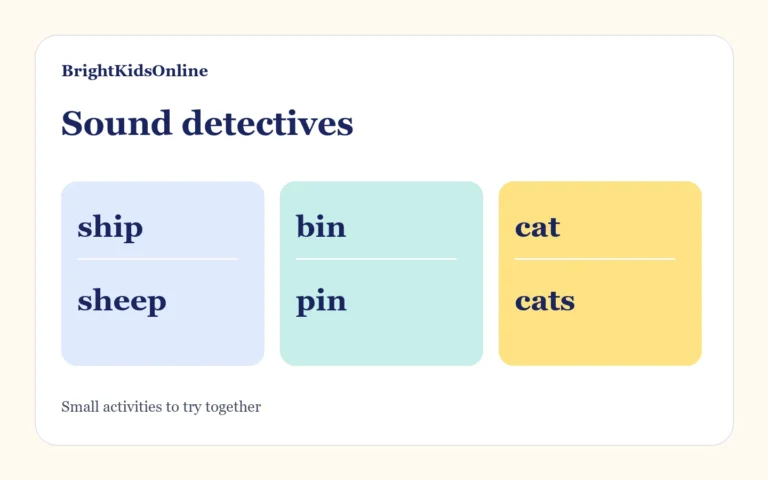
| ship / sheep | A different vowel sound, not simply a longer version of one vowel. | “Is it a ship or a sheep?” |
| bin / pin | The beginning of the word changes. Listen before trying the lip movement. | “Put the paper in the bin.” |
| cat / cats | A final sound can change the message from one animal to more than one. | “I can see two cats.” |
| banana / computer | One syllable is stronger: ba-NA-na, com-PU-ter. | “I use a computer.” |
For ready-to-use prompts and an answer sheet, try the English pronunciation games and free sound activity pack. Begin with the easiest task rather than working through every page.
Choose a sound model you trust
Use a dictionary recording, a suitable story or a short song from a reliable learning source. Cambridge Dictionary provides British and American recordings. Either can be useful; use the same model when comparing two words. Do not treat a difference between accents as a mistake.
If you are unsure of your own pronunciation, listen together. You do not need to become a pronunciation expert to be a helpful partner. Avoid relying on an automatic speech score to decide whether a child is “good” at English.
Give feedback that keeps the conversation open
If the meaning is clear, answer it first: “Two cats? Where are they?” If you did not understand, ask a genuine checking question: “Did you mean a ship or a sheep?” Offer one model and another chance, rather than a long explanation.
Choose a separate quiet moment for a sound your child wants to work on. Public corrections, comparisons with other children and repeated demands to “say it properly” can make an ordinary conversation feel like a performance.
Adapt the task, then return to real conversation
For ages 6 to 8, use objects, pictures and pointing. For ages 8 to 10, add a guessing game. For ages 10 to 14, let your child choose useful phrases, short dialogue or a topic they care about. Age is a starting point; their experience with English matters too.
Sound practice works best as one small part of learning. Pair it with vocabulary activities, shared reading and everyday English communication activities. If speaking itself feels uncomfortable, start with the guide to speaking confidence.
In my online English lessons for children, I adapt listening, conversation and games to what the child needs. You can tell me which words or situations feel difficult during a free 30-minute introduction. These activities support language learning; they are not speech therapy or a developmental assessment.
Further reading
Common questions
What parents often ask
Both can provide useful models. Use one consistent recording when comparing sounds, but help your child understand that English has many accents. Being understood matters more than copying one accent perfectly.
Use a reliable dictionary recording or a suitable learning clip and listen together. You can support a choice, a picture or a conversation without providing every sound model yourself.
Try a short activity of about five minutes and adapt it to your child. Stop when they are tired or frustrated; it is a practical suggestion, not a required schedule.