
Free printable PDF
Keep the conversation going
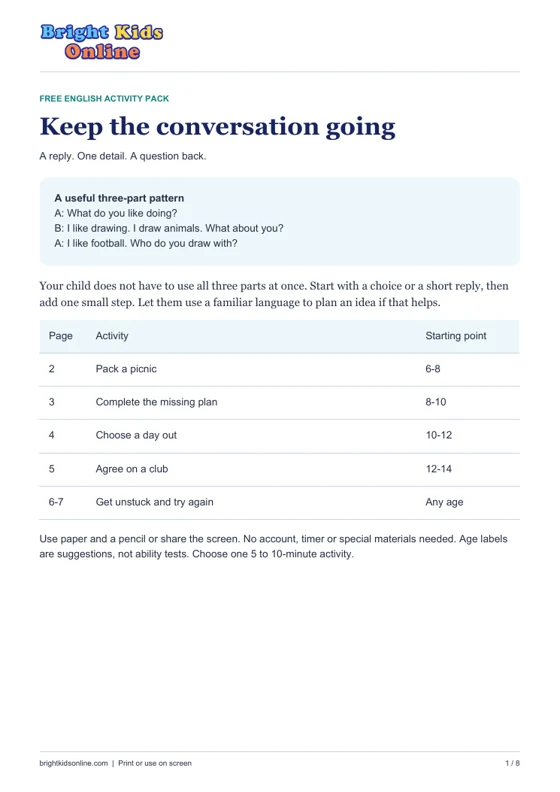
8 A4 pages with English instructions, practical activities and answers. No sign-up.
Choose the activity that fits your child’s current English. Ages are starting points, not levels.
Give your child a reason to communicate in English: choose a snack, explain a drawing or make a small plan together. Accept a short reply, invite one detail and ask a question about the answer. Take your own turn too. Conversation grows through listening and responding, not just reciting a longer sentence.
A child can remember vocabulary yet still need help using it with another person. They may be unsure how to ask back, check a word or continue when they get stuck. The activities below practise those specific moves. They support English learning, not speech therapy or a developmental assessment.
A reply, one detail and a question back
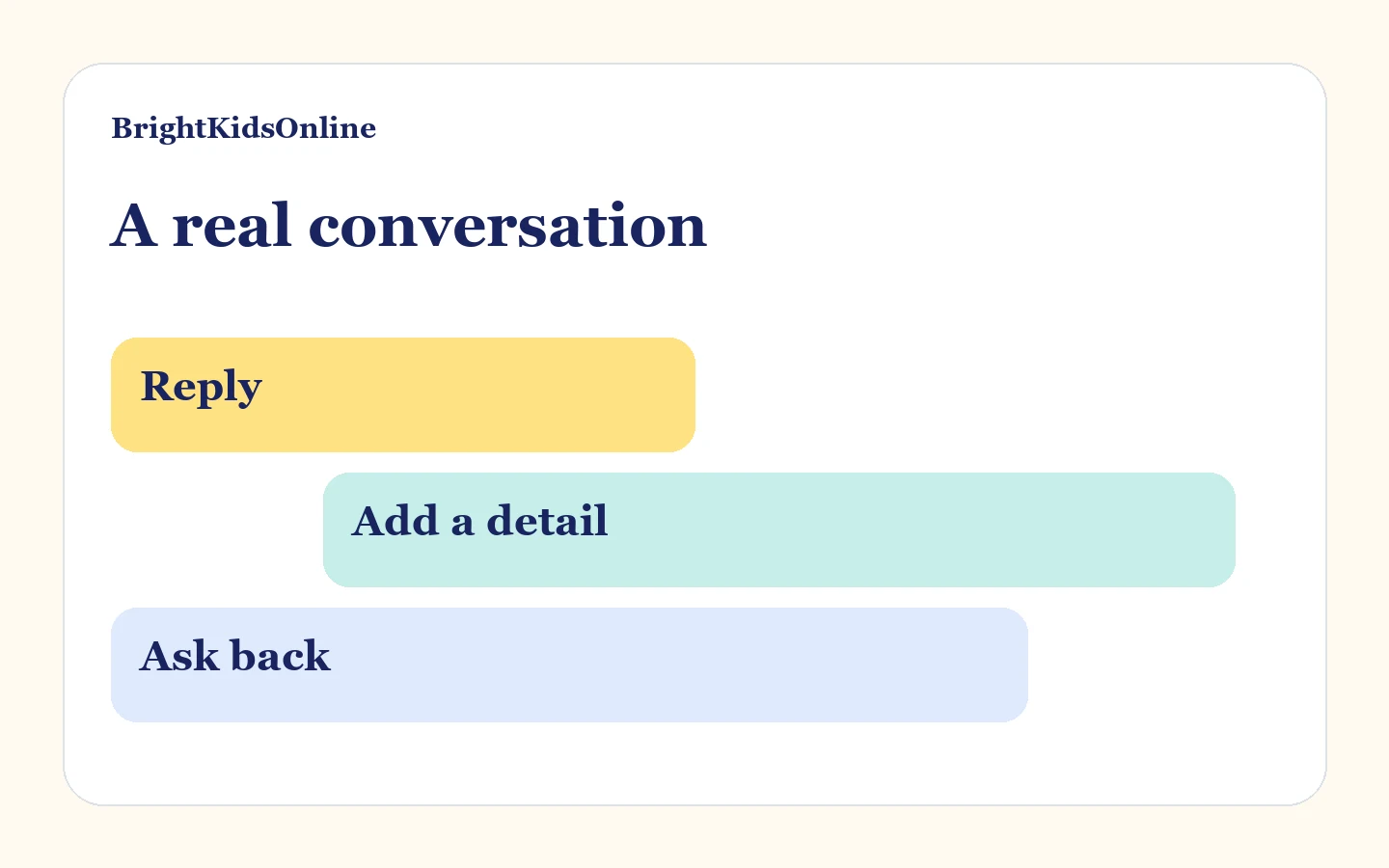
Try this pattern: reply + detail + ask back. “I like drawing. I draw animals. What about you?” gives a partner something to respond to. It is a flexible support, not a script to force into every conversation.
Start with the part your child can manage. “Drawing” can become “I like drawing” before adding anything else. If they cannot find a word, offer a choice, a picture or a phrase beginning. Let them plan an idea in a familiar language if that helps.
Ages 6 to 8: pack a pretend picnic
Draw four choices: an apple, a banana, a sandwich and water. Each person secretly chooses two. Ask “Do you have an apple?” and “What do you have?” Pointing, a word or a supported phrase can all keep the exchange going.
After a successful turn, add a detail: “My apple is red.” Then ask back: “Do you like apples?” The printable includes a picnic page, but real objects or your own drawings work too. Avoid turning it into a memory test.
See how I adapt English lessons for ages 6 to 8.
Ages 8 to 10: find the missing information
Give each partner a different part of a weekend plan. One knows the weather and activity; the other knows the transport. They need to ask “What is the weather like?” or “How are we getting there?” to complete it. The partner genuinely knows something they need.
Once the plan is complete, add a question without a written answer: “What food shall we take?” This moves from finding information to making a choice together. The pack contains two ready-to-use cards and an answer page.
For guided practice at this stage, explore English for ages 8 to 10.
Ages 10 to 12: agree on a day out
Offer a small pretend budget and a few options: a free park visit, a museum, an ice cream stop and a bus journey. Ask your child to propose a plan, give a reason and check the cost. The point is to explain a choice and respond to someone else’s preference.
Introduce one new detail: “It starts to rain.” Would they keep the plan or change it? Accept more than one sensible answer. Use “Could we… instead?” or “What do you think?” when your child needs a way into the next turn.
The activity also connects with English lessons for ages 10 to 12.
Ages 12 to 14: compare ideas without a script
Choose a topic your child would actually discuss, such as a club, a hobby or a weekend plan. Give each person a different preference. Ask them to explain it, listen to a question and consider another option. “I’d prefer… because…” is a useful beginning.
Invite a short chain of turns: suggest, ask, answer, offer another idea, compare and decide. Do not measure success only by seconds spoken. A thoughtful reply or a relevant question can be a better next step than filling silence.
See English for ages 12 to 14 for the lesson approach. Younger beginners can also use a simpler version of this task.
Teach a way to continue when words disappear
Asking for help is part of communication. Practise “Could you say that again, please?”, “What does that mean?” and “How do you spell it?” A younger beginner can use “Again, please.” Model a helpful response when your child asks.
If a word is missing, describe it: “It’s something you use to draw.” Pointing or asking for a word can keep an exchange alive. Correct one useful point later, rather than interrupting every turn.
Notice the communication, not just the errors
After an activity, ask “What helped?” or “What would you like to talk about next time?” Notice a specific action: your child listened to the reply, added a detail or asked for clarification. A tired or reluctant child can stop; the challenge is an invitation.
For children who worry about speaking, read the confidence guide. If a particular word is hard to understand, use a short pronunciation routine alongside conversation rather than replacing it.
My online English lessons use conversation, games and activities adapted to your child. You can share what they enjoy and where they get stuck in a free 30-minute introduction. We can then discuss a useful starting point.
Further reading
Common questions
What parents often ask
Respond to the word first, then offer a small phrase beginning or a choice. Model one detail yourself and take turns. Your child does not need to use the whole reply-detail-question pattern immediately.
Start with two useful turns on a familiar topic. Add a detail or a question when that feels manageable. Avoid judging progress only by a timer; listening and asking for help are useful communication skills too.
No. Choose the task according to your child’s English, interests and comfort. A beginner aged 12 may need the simpler choices, while another child may be ready for a more independent exchange.